Showing posts with label form. Show all posts

Monday, 10 October 2016

Form Photographer Research

             Imogen Cunningham

 Imogen Cunningham was an American photographer who was well known for her form and nude photography. She photographed objects in a intriguing way, catching the eye of many people. She used shadow a lot during her form photography work which clearly has an effect of drawing people in. She focused a lot of living objects such as flowers; taking into account that she focused of form, living objects probably intrigued her because of the way they naturally grow and therefore, the form that they hold.


  This picture was taken by Imogen Cunningham and is of flowers. She is popularly known for her photographing of objects which represent form. The flowers are casted in different lightings - the flower at the back is barely visible and we can only really see the outline of the form. This outlines the fact that the details of the object are not really important, but only the form is. She has incorporated tone within her work to create dark shadows. The flowers present a spiral shape and they all roll into one. Most of Imogen's work is in black and white which creates strong and powerful contrasting effects.


This picture was also taken by Imogen and is again of a flower. The flower holds an unusual form and is hard to work out what type of flower it is. It again holds the spiral shape which is interesting to the eye. There are some serious contrasted tones here which is important when photographing form because shadows and lights and the intensity that they are can change the form of an object completely. For example, the bottom section of the photograph contains an intense shade of black; this makes it hard to work out what the object is because we cannot clearly see the form which it holds. There are other objects in the picture but they are not dominant. Objects such as the spikey plant are also intriguing to look at because they hold an unusual shape. Imogen has consciously picked out particular objects to photograph and positioned them in a specific way to create a photograph that draws people in.


Here is another example of Imogen Cunningham's work. When looking at her work, it is not difficult to see that it presents a pattern; she focuses of similar objects especially flowers. Despite this, she photographs them in different ways, showing different amount of specific tones each time. For example, there are more soft tones in this picture compared to the ones pictured above. I like this photograph of hers because the background is muffled and isn't just one block colour; it almost looks like someone has smeared different grey and white tones together, The form of the vase which the flowers sit in is vague and almost is camouflaged into the background - we can only see a mere outline of it. The flowers all hold a similar form to one another which would appear bland to some people if Imogen had photographed it normally.


Monday, 3 October 2016

Form Image Bank

  I chose this photograph as one which inspired me because I like the spiral shape that shells create. This is a object which I can use to create a more interesting way to present line. When photographing form, it works best when presented on a plain background, so we can really focus on what's happening in the foreground and what form does the object hold rather than getting drawn away by the colourful/patterned background. I would like to use the idea of photographing shells in the topic form.


  I chose this picture as one which inspires me because I like the idea of taking an object belonging to nature and photographing the way in which it naturally grows and therefore, the form which is holds. Pine cones create an interesting outline because there are gaps within it - this is more interesting than photographing a pear (for example).  Again, the background is blurred and plain which it good because it does not overpower the object which we are meant to be looking at and what we are meant to be looking for.


  I chose this photograph as one which inspired me because I like how it is in black and white - this avoids distractions even further because there is little else to focus on other than the form. I also like how the petals of the flower and pointing downwards and are not a visible. This forces us to look more closely at the middle of the flower and the shape which this creates. I like the idea of photographing flowers to represent form because it is again, something which grows naturally and I think that it is more interesting to look at how objects form naturally and the shape which the make rather than something that have been deliberately made (for example a statue) to create a specific shape.


  Lastly, I chose this photo as one which inspired me because I find how by photographing water and the processes of it splashing, it really interesting because it is hard to capture these details. In this photo shown, the water is shown in different stages - the first stage is the balloon, which takes a pretty smooth form however, once burst, the balloon disappears and the water holds a similar shape to the balloon however is more jagged. Furthermore, the last shape is completely distorted which I find really interesting.

Form Straight Images


 I chose this image as one which represents the subject topic of form because I like how the flowers are shrivelled due to them dying. The flower is not as alive as a fresh flower would be which creates the 'wrinkly' effect shown here. I think that it is more interesting than having an alive flower because it consists of a different texture and different patterns. In an alive flower, the petals are almost all the same but in comparison as shown here, the individual petals are different shapes due to the way they have shrivelled. This creates a more interesting form compared to if I had photographed an alive flower. The white background contrasts against the off cream/white colour that the flower has and the shadows created around the flower reflect the form even more.


  I chose this image as one which inspired me because I liked how the spikiness of the cactus create an odd shape. It is not just a typical 3D shape which represents form but is unusual. I like the shadows which are casted by the spikes on the cactus. The shadows almost make it seem like there are extra spikes on the cactus but actually, there isn't, it's just the shadows made by the existing spikes. I like how the angle shows the form of the cactus and how the spikes extend at all different lengths and directions.


  I chose this picture as one of my favourite because it shows a more unique shape rather than photographing a basic three dimensional picture as a way of presenting form. The way that the statues have been carved create ridges which then presents a different shape. In this photograph, the two different statues are seen as holding individual forms. This is because of the way that I have consciously positioned them and photographed them.


  I chose this photo as one which represents form because I like how the oval shape is presented and how you can see through the object, onto the background. Not only this, but the round candle represents form also. The two shades of white contrast against each other although being similar - the shadows reflected by the object make the white background appear darker. When photographing form, it is important to show incorporated shadows within the images which I feel like this picture does well.


  I really like this photo. In my opinion, photographing several images in one picture is more effective than just looking at the form which one specific image holds. The jagged edges of the candles create an intriguing representation of form. The photo is very focused and shows not only form but texture and colour also. It is important to incorporate different subject topics into one because they all fit in together.

Form Work Diary

Planning


Evaluation


   I chose this picture as one which represented form well because it includes a lot of shadows which is important when photographing form. The flowers and leaves are withering which presents a unique form which is different to those of fresh flowers. Flowers represent life and it is interesting to look at how they grow and blossom, wither and die and therefore, the variety of forms they hold within their life cycle. The picture is very focused and it is clear to work out the texture of the plant. The leaves looks 'crunchy' and it makes us think about what kind of texture they have if we were to feel them in real life. The topic texture works well with form. For example, if the soft petal that we can see, look crunchy like the leaves, it may change what we think about the texture they hold.

Progression


    To edit this photograph, I used Photoshop to zoom into the part of the object that I wanted to be the main focus (the top part, cutting out some of the background). I enhanced the shadows within the picture by adjusting gamma correction, vibrancy and exposure. The intensified shadows presented the object holding a more distorted form. The individual outlines are specific to each flower, all holding a different form, now intensified by the adjustments I have made using Photoshop. If I were to take this photo again, I would take a variety of picture, some at closer angles to show the individual forms that each flower holds. I would then use Photoshop to make adjustments to see which pictures work best.

Evaluation

  I like this image because it has a really unique form. It is a static object which is built from metal. It is uncommon to see figures which are built from metal because most statues are built from stone etc. The material it is built from has made it able to create a more unique structure. The material looks woven as there are gaps in the figure. The figure looks like  person running and is very large. I like this photograph because it is eye catching.


Progression


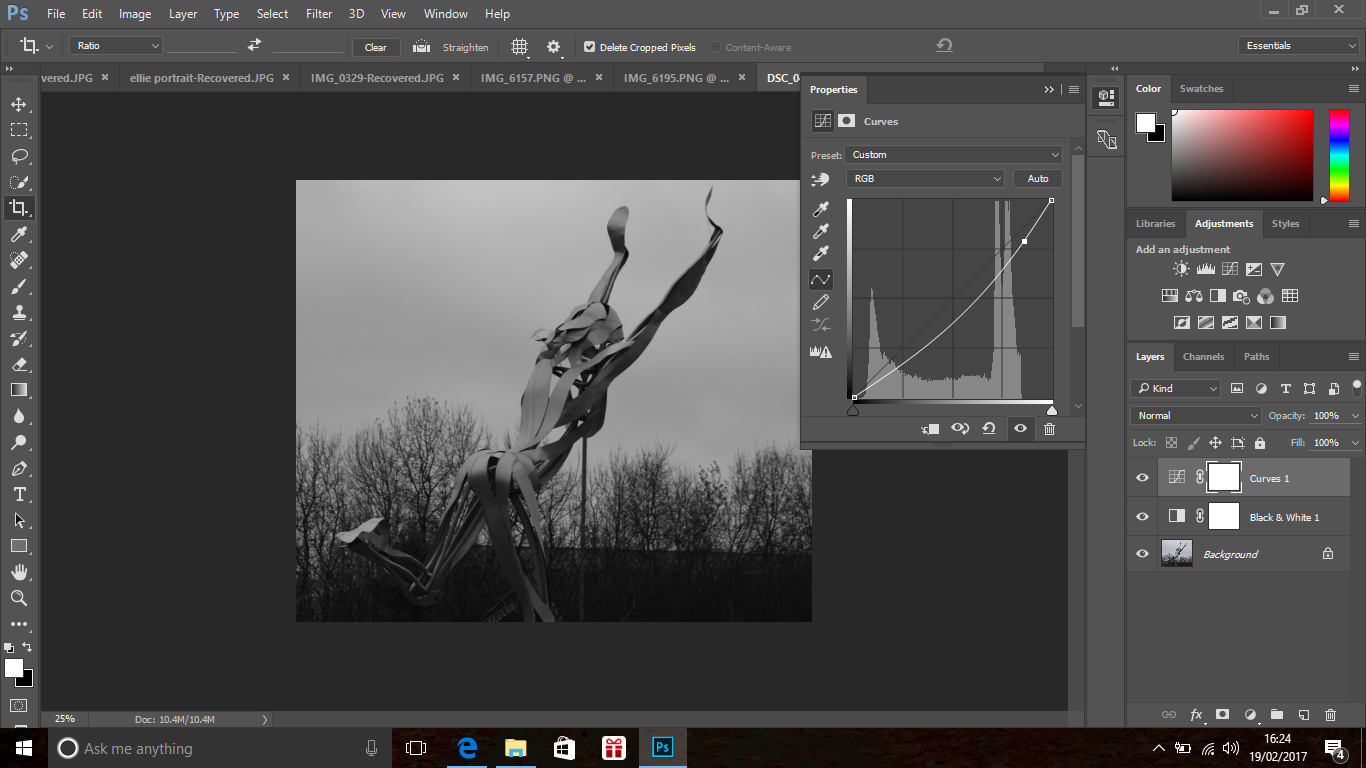
  I used Photoshop to make this picture more appealing. The original picture was fairly dull and didn't supply much excitement. Our eyes are not immediately drawn to it because there is no contrast and there is too much background in the original image. Therefore, I used Photoshop to crop parts of the background out and to make it more contrasted. The metal figure is now more contrasted against the sky and there is less background space to avoid unnecessary distractions. I used the 'curves' selection to make everything in the image more defined and contrasted. If I were to take this picture again I would probably take a selection from a smaller distance away and focus on the form of certain sections rather than the whole object. I would also take another selection of images from different angles and possibly using a tripod to avoid cutting part of the object out when taking the picture.


Evaluation


  This is my favourite image which I took within this project of 'form photography' because I have focused the image well, evaluating the form of one single flower. The rest of the flowers in the background are unfocused and we cannot visibly see the definite form that they hold. I like how the bright yellow contrasts with the orange skyline because it creates a good base for the follower to significantly stand out against.


Progression

   In my opinion, my form project wasn't particularly successful because I don't feel that it showed my full potential as a photographer. I needed to explore different areas and focuses on more interesting forms. I also needed to use different angles and lighting to evaluate which ones work best to show form in a more intriguing way.

To progress this project further, I returned to this focus and looked at the different ways in which I could show more potential within my work.

    Here, I took an image of a prickle plant which has grown from the ground and formed a unique shape. I liked the harsh look to it and how the form was particularly uncontrollable. I think that this adds more of a range to my form photography. The soft texture of the underlying grass contrasts with the sharp texture of the object. I like this image because it is not dull or uninteresting, unlike some of my opposing images within this subject.


Form Definitions

Form - the visible shape or configuration of something. It is a three dimensional shape such as a cube, sphere or cone. In photography we used tone an perspective to create an illusion of form. 


This is an example of form photography - you can clearly see the shape of the difference shapes within the object. It shows density and lines within the object.