Showing posts with label Defintions. Show all posts
Showing posts with label Defintions. Show all posts
Monday, 12 December 2016

Monday, 28 November 2016
Portraiture Definition Post
A portrait is a painting, photograph,
sculpture, or other artistic representation of a person, in which the face and
its expression is predominant. The intent is to display the likeness,
personality, and even the mood of the person.
Portraiture - A painting, drawing, photograph, or engraving of a person, especially one depicting only the face or head and shoulders

I like this image because you can see the emotion of the little girl's face. This makes us think deeper into why she may be pulling this face etc. I like the dark background because it reflects her emotion.

This image does meet our standards of a poetical/war hero because the expression on his face looks grumpy. Stereotypically as a prime minister (which he was during World War II), you would think of them as harsh and powerful. The dark and harsh lighting really brings out the masculinity and dominating look that he wished to portray to the wider population.

This image represents femininity through extreme makeup such as the big lips and heavy eye makeup. This woman is transgender and has aimed to represent Marilyn Monroe. This image in general is fairly extreme and the way that she is laying against the leopard print background is eccentric. This could portray being comfortable within your own skin and expressing who you are which may be important to this individual due to being transgender.
Monday, 21 November 2016
Landscape Definition Post
Landscape - all the visible features of an area of land, often considered in terms of their aesthetic appeal.


This picture is of a picteresque landscape.
Ansel Adams Landscape Photography

Ansel Easton Adams (February 20, 1902 – April 22, 1984) was an American photographer and environmentalist.
Group f/64 was a group of seven 20th-century San Francisco photographers who shared a common photographic style characterized by sharp-focused and carefully framed images seen through a particularly Western (U.S.) viewpoint.
The Zone System is a photographic technique for determining optimal film exposure and development, formulated by Ansel Adams and Fred Archer.
Pictorialism is the name given to an international style and aesthetic movement that dominated photography during the later 19th and early 20th centuries.
An approach to photography that emphasizes beauty of subject matter, tonality, and composition rather than the documentation of reality.
Methodology - a system of methods used in a particular area of study or activity.
Monday, 14 November 2016
Joiners Definitions
Joiners - In
the early 1980s, Hockney began to produce photocollages, which he called
"joiners," first of Polaroid prints and later of 35mm, commercially
processed color prints.

This is an image of a crowded town which has been assembled by someone. They have misplaced some parts of the picture, turned pieces around to create different angles. We as human beings can work out what is happening within the picture despite the picture being aligned and set out how we imagine it in our heads. This is why I find the topic joiners interesting.
Examples of David Hockney's work:


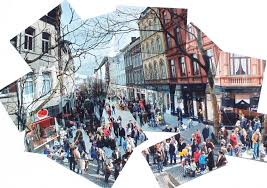
This is an image of a crowded town which has been assembled by someone. They have misplaced some parts of the picture, turned pieces around to create different angles. We as human beings can work out what is happening within the picture despite the picture being aligned and set out how we imagine it in our heads. This is why I find the topic joiners interesting.
Examples of David Hockney's work:


Monday, 7 November 2016
Recording Motion Definiton
Freeze frame - A freeze frame shot is used when one shot is printed in a single frame several times, in order to make an interesting illusion of a still photograph.

Motion blur - is the apparent streaking of rapidly moving objects in a still image or a sequence of images such as a movie or animation. It results when the image being recorded changes during the recording of a single exposure, either due to rapid movement or long exposure.
 \
\

ISO - in Digital Photography ISO measures the sensitivity of the image sensor. The same principles apply as in film photography – the lower the number the less sensitive your camera is to light and the finer the grain. Higher ISO settings are generally used in darker situations to get faster shutter speeds.
Aperture - A device that controls the amount of light admitted through an opening.
Shutter speed - the nominal time for which a shutter is open at a given setting.

Motion blur - is the apparent streaking of rapidly moving objects in a still image or a sequence of images such as a movie or animation. It results when the image being recorded changes during the recording of a single exposure, either due to rapid movement or long exposure.
 \
\
ISO - in Digital Photography ISO measures the sensitivity of the image sensor. The same principles apply as in film photography – the lower the number the less sensitive your camera is to light and the finer the grain. Higher ISO settings are generally used in darker situations to get faster shutter speeds.
Aperture - A device that controls the amount of light admitted through an opening.
Shutter speed - the nominal time for which a shutter is open at a given setting.
Note:
The main f stops in your camera are 2.8,4.0, 5.6, 8,11,16,22, 32. for each increase in f stop value the amount
of light entering the camera is reduced by a half.
Thursday, 3 November 2016
Framing Definition Post
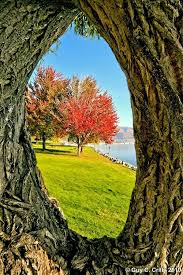
Framing - is simply using other objects in your photograph to frame the main subject. This is probably one of the easier composition techniques in photography. Framing brings more depth to the picture and a better focus on what the main subject is.

Monday, 31 October 2016
Reflection Definition Post
Reflection - The throwing
back by a body or surface of light, heat, or sound without absorbing it.
Although not strictly a FORMAL element, REFLECTION IS an important consideration in FRAMING a composition and establishing BALANCE.

Rule of thirds - The basic principle behind the rule of thirds is to imagine breaking an image down into thirds (both horizontally and vertically) so that you have 9 parts.
Golden Section - The Golden Ratio In Photography. Some argue that the rule of thirds is an oversimplification of a more advanced mathematical equation known as the golden ratio (also known as the golden mean). The golden ratio is a ratio which has continued to surprise artists, scientists, musicians and mathematicians for centuries.

This is an example of surrealism within reflection photography.
Although not strictly a FORMAL element, REFLECTION IS an important consideration in FRAMING a composition and establishing BALANCE.

Rule of thirds - The basic principle behind the rule of thirds is to imagine breaking an image down into thirds (both horizontally and vertically) so that you have 9 parts.
Golden Section - The Golden Ratio In Photography. Some argue that the rule of thirds is an oversimplification of a more advanced mathematical equation known as the golden ratio (also known as the golden mean). The golden ratio is a ratio which has continued to surprise artists, scientists, musicians and mathematicians for centuries.

This is an example of surrealism within reflection photography.
Monday, 17 October 2016
Shape Definitions
SHAPE (definition).
•A
shape is an area enclosed by a line. It could be just an outline or it could be
shaded in.
•Shapes
can be either geometric, like a circle, square or triangle,
or irregular.
•When
drawing shapes, you must consider the size and position as well as the shape of
the area around it. The shapes created in the spaces between shapes are
referred to as negative space.
Shape - the external form, contours, or outline of someone or something.
 I like this photo of shape because it has a deep meaning. The elephants are creating a heart shape which could represent them being in love. The warm sunset in the background works well with the idea of love.
I think that this photo does not represent sexual objectification because the woman has is almost shielding herself, despite her being exposed. The photographer has used negative space to highlight the body of the woman. This links to what he wanted to look into - the female form.
Monday, 10 October 2016
Tone Definitions
Tone (definition).
•This
refers to the lightness or darkness of something. This could be a shade or how
dark or light a colour
appears.
•Tones
are created by the way light falls on a 3D object. The parts of the object on
which the light is strongest are called highlights and
the darker areas are called shadows.
There will a range of tones in between the highlights and shadows.
•Without
tone Form does
not exist, tone is therefore an important aspect in the visualisation of
3D objects.


This photo shows tone very well. There are several different tones incorporated into this photo which we can find on the Ansel Adams Zone System. The light is reflected onto her dress where we see the patches which are highlighted. Her face has some dark tones and light tones where the light is reflected onto her face at different angles.

The tones shown in this photo are more masculine tones. This is because the dark tones on his beard and his t-shirt match with a male gender. The dark tones are more harsh which may refers to males more rather than females.

The tones are lighter in this picture which refers best to femininity. The soft light tones look more dainty and elegant which we stereotypically refer to a female.
Pictoralism - Pictorialism is the name given to an international style and aesthetic movement that dominated photography during the later 19th and early 20th centuries.Almost looks old fashioned. Some brush stokes etc may be visible.
Monday, 3 October 2016
Form Definitions
Form - the visible shape or configuration of something. It is a three dimensional shape such as a cube, sphere or cone. In photography we used tone an perspective to create an illusion of form.
 This is an example of form photography - you can clearly see the shape of the difference shapes within the object. It shows density and lines within the object.

Monday, 26 September 2016
Pattern Definitions
Pattern is an underlying structure that organizes surfaces or structures in a consistent, regular manner.
Pattern can be described as a repeating unit of shape or form, but it can also be thought of as the "skeleton" that organizes the parts of a composition.

Patterns
are simply repeated shapes, colours or objects, ordered in either regular or
irregular formations. As a photographer, using pattern is key to good
composition and, when used effectively, can transform an otherwise bland image
into something dramatic and eye catching. Patterns are formulated all around us
- in both natural and man made settings.
Texture Defintions
Texture refers
to the tactile qualities of the physical surface of the object.
Texture can be accentuated by the side light of early sunny mornings or early evenings, or by overhead light when the sun is vertical and high in the sky.

 The photographer has shown texture through the still life image of food. The food is spiky on the outside.
Irregular Patterns
Texture can be accentuated by the side light of early sunny mornings or early evenings, or by overhead light when the sun is vertical and high in the sky.

 The photographer has shown texture through the still life image of food. The food is spiky on the outside.
Regular Patterns
Some
of the most rewarding patterns to shoot consist of shapes, lines or colours that
repeat in a strict formation. Filling a frame with clear-cut lines or a
consistent geometric formation.Irregular Patterns
There
is often the presumption that a pattern has to involve straight lines to
produce something recognisable as a
pattern, but this is not the case.
In the
natural world, patterns can be found in irregular formations and, in direct
contrast to regular formations
Monday, 19 September 2016
Colour Definitions
Colour - Colour is the element of art that is produced when light, striking an object, is reflected back to the eye. There are three properties to colour. The first is hue, which simply means the name we give to a colour (red, yellow, blue, green, etc.). The second property is intensity, which refers to the vividness of the colour.
 I chose this photo because I like the way that here is a group of flowers however, only one flower is coloured. This makes me feel like the flower that is pink, is the only one which is actually alive. This is because when you think about flowers, you wouldn't think about them being black and white (they're usually pretty, bright colours).
Psychology of colour


Red - suggests physical courage, strength, warmth, romance and excitement. However, in it's negative light it could suggest violence, strain and defiance.

Yellow - implies optimism, confidence, self - esteem, extraversion, emotional strength, friendliness and creativity. It's negative side may suggest fear, irrationality, depression, anxiety and emotional fragility.
(I agree with this colour definition however, I think it also represents happiness and new life. I also do not think that it represents depression, fear, anxiety or emotional fragility. Looking at the colour yellow gives me a sense of happiness and does not make me feel sad or fragile in any way).


I think that the colour purple is a hard colour to pinpoint a specific meaning to. However, I think that this image is good at representing luxury. The dress looks almost royal

 This picture makes me feel happy and refreshed. The yellow colours in the picture suggest confidence and self esteem, clearly shown by the woman in the picture. The colours in the picture are very bright - they suggest happiness and control. The children in the photo look like they're enjoying themselves and that it is a happy scene.
Muted colours - When you take a colour tone, and you mix it with white or grey, it dulls it down to make the colour less. bright or in other words it makes it muted or mute.
Saturated colours - Colour saturation refers to the intensity of colour in an image. In technical terms, it is the expression of the bandwidth of light from a source. The term hue refers to the colour of the image itself, while saturation describes the intensity (purity) of that hue.

This picture is a good example of analogous colours. The colours in this picture are red, orange and yellow. These colours work well together and 'get along'.
 This picture is a good example of complementary colours. The colours in this image are red and green. Quite obviously, the colour which stands out is the red. This is because the colours red and green are opposite to each other on the colour wheel and therefore each separate over stands out more. In the picture above, the individual colours stand out less than the colours in this picture due to the fact that the colours above are analogous.

Psychology of colour

This picture fits well with the idea that the colour blue represents depression or a sad mood. The man walking alone is dressed in black which can also be implied as a sad colour. The fact that he is alone and the atmosphere is blue could suggest that he is sad or alienated.
Blue - suggests coolness, distance,
spirituality, or perhaps reserved elegance. Some shade of blue is flattering to
almost anyone. In its negative mode, we can think of the "blues"-the
implication being one of sadness, passivity, alienation, or depression.
This picture works well with the idea of red being connected to romance. A red rose is stereotypically linked to love and relationships.
Red - suggests physical courage, strength, warmth, romance and excitement. However, in it's negative light it could suggest violence, strain and defiance.

Looking at this picture of a yellow filled field makes me feel happy and 'summery'. Even though the sky is dark, I still feel a sense of happiness. I do not think that the picture implies fragility or depression at all because the field is complete and perfect - it is a block of yellow.
Yellow - implies optimism, confidence, self - esteem, extraversion, emotional strength, friendliness and creativity. It's negative side may suggest fear, irrationality, depression, anxiety and emotional fragility.
(I agree with this colour definition however, I think it also represents happiness and new life. I also do not think that it represents depression, fear, anxiety or emotional fragility. Looking at the colour yellow gives me a sense of happiness and does not make me feel sad or fragile in any way).

I think that this image is a good example to represent the colour green because it represents nature and life. However some people may suggest that this also applies to the bland side of the colour green because there isn't very much going on in the photo. The trees are all alive which could give a refreshed feeling.
Green - Positive: Harmony, balance, refreshment, universal love, rest, restoration, reassurance, environmental awareness, equilibrium, peace.
Negative: Boredom, stagnation, blandness, enervation.
I think that the colour purple is a hard colour to pinpoint a specific meaning to. However, I think that this image is good at representing luxury. The dress looks almost royal
Purple - Positive: Spiritual awareness, containment, vision, luxury, authenticity, truth, quality.
Negative: Introversion, decadence, suppression, inferiority.
Orange - Positive: Physical comfort, food, warmth, security, sensuality, passion, abundance, fun.
Negative: Deprivation, frustration, frivolity, immaturity.
Pink - Positive: Physical tranquillity, nurture, warmth, femininity, love, sexuality, survival of the species.
Negative: Inhibition, emotional claustrophobia, emasculation, physical weakness.
Negative: Inhibition, emotional claustrophobia, emasculation, physical weakness.
Grey - Positive: Psychological neutrality.
Negative: Lack of confidence, dampness, depression, hibernation, lack of energy.
Black - Positive: Sophistication, glamour, security, emotional safety, efficiency, substance.
Negative: Oppression, coldness, menace, heaviness.
This picture can be interpreted as showing sadness because of the blue shade shown. The woman in the photo doesn't look happy and looks as if she has a lot on her mind (as if she is isolated). The woman in this image is Lily Allen who sings slow songs - this links with the somber mood that the colour blue creates.
 This picture makes me feel happy and refreshed. The yellow colours in the picture suggest confidence and self esteem, clearly shown by the woman in the picture. The colours in the picture are very bright - they suggest happiness and control. The children in the photo look like they're enjoying themselves and that it is a happy scene.
 Muted colours - When you take a colour tone, and you mix it with white or grey, it dulls it down to make the colour less. bright or in other words it makes it muted or mute.
Saturated colours - Colour saturation refers to the intensity of colour in an image. In technical terms, it is the expression of the bandwidth of light from a source. The term hue refers to the colour of the image itself, while saturation describes the intensity (purity) of that hue.
.
Analogous - Three of four colours that are next to each other on the colour wheel. They are also known as harmonious because they compliment each other and 'get along'. They have a soothing effect and are often used in visual design. 

This picture is a good example of analogous colours. The colours in this picture are red, orange and yellow. These colours work well together and 'get along'.
Complementary - colours are opposite to each other on the colour wheel, e.g.
Blue-violet and yellow, represent colours positioned across from each other on
the colour wheel. Complimentary colours exhibit
more contrast when positioned adjacent to each other.
 This picture is a good example of complementary colours. The colours in this image are red and green. Quite obviously, the colour which stands out is the red. This is because the colours red and green are opposite to each other on the colour wheel and therefore each separate over stands out more. In the picture above, the individual colours stand out less than the colours in this picture due to the fact that the colours above are analogous.
Subscribe to:
Posts (Atom)